About

Before color grading was a button on a screen, I was studying painting and chemistry at university — without realizing it was setting me up perfectly for film, a craft that lives right at the intersection of the technical and the artistic. There I was standing in a film lab scanning and printing actual film stock, seeing how an image is transformed, 15 years before I ever touched a digital control surface. It's why skin tones and the physical behaviour of light still come first in my grades, not the tools. Many years, countries, and projects later, that same instinct is still what I lead with.
Fady Melek is a senior colourist with 15+ years of experience in the film industry. Having studied Art and Chemistry at university, Melek made a transformative leap into film in 2009, quickly accumulating over 30 feature film credits. After leaving Egypt in 2011, he joined Technicolor, working on major films including Taken and Transporter. In 2017, he joined Katara Studios in Qatar as senior colourist, a role he held until 2024. During his time there, Katara Studios received the 2024 Global Recognition Award and won five Gold Telly Awards for projects graded by Melek on Baselight 6.0: the HADAF music video, the film Kalilah and The Lost Chapter of Kelileh & Demneh, and the TV series Medinah. Melek is now based in São Paulo, Brazil, working as a freelance senior colourist.
“Can you tell us about your journey to becoming a colourist?”
F: My journey began working in scanning and printing during the digital intermediate (DI) era. Colour correction was introduced to me and I immediately fell in love—it combined two of my favourite
things: painting and technical knowledge. I became a colourist’s assistant and worked my way up to senior colourist at Katara Studios.
“Tell us more about your experience as a film lab technician and how it influenced your transition to colour correction?”
F: I went to university to study chemistry and in my third year worked in a film laboratory in Egypt. We received films to scan and print, and I was immediately drawn to the art of cinema. Working in a lab, you understand the power of printing lights and how they can completely transform a film’s look. When I moved into colour grading, I opted for a globally homogeneous effect on the image rather than a look based on masking and keying.
“Tell us about your role and work at Katara Studios.”
F: Working as senior colourist and head of image, I colour grade and develop the look of almost all content produced by the studio—from feature films, TV programmes and music videos to documentaries and commercials. I also design the pipeline for VFX and on-set
visualisation in both SDR and HDR. It has been a remarkable period, both for the technical level and for being surrounded by like-minded professionals. It’s inspiring!
“You work across a wide variety of content. How do you manage this diversity and do you prefer any format?”
F: At Katara Studios, we are exposed to all formats. One day I’m working on a feature film, the next I’m grading a World Cup music video. The credit goes to our post-production team who developed a pipeline that makes us very efficient. I enjoy all formats, but at the end of the day, I remain a film lover at heart.
“How would you describe your colour grading style?”
F: I prefer not to have a specific
style—I focus on what each project needs. However, I pay great attention to skin tones and how they are reproduced, as that is what I use as a reference for balancing and developing the look.
“Tell us more about how you work with skin tones.”
F: Manipulating skin tones is delicate and extremely important. The viewer focuses heavily on this part of the image, and much of the story’s emotions are conveyed through skin tones. Chromogen is my main tool. Colour cross talk and selective brightening of skin tones separately from the rest of the image are powerful approaches.
“You have experience with several colour grading systems. What makes Baselight your tool of choice?”
F: The answer is simple—a solid workflow and reliable tools. Baselight offers the flexibility needed to work the way you prefer. But for me, the innovation in tools is unmatched. When FilmLight launches a new tool, you can be certain it will not let you down or compromise the image mid-project.
“Have you explored Baselight 6.0? If so, what are your impressions?”
F: Baselight 6.0, with the addition of tools such as X Grade, Chromogen and all the spatial tools, has made colour grading faster and more enjoyable. With these new tools, the sky is the limit for what the image can become.
“How important is look development and how do you approach it?”
F: I always take time to speak with the DoP and production team to create a look that serves as the show LUT—typically scene-referenced under a specific DRT. After that, my colour correction becomes a harmony of subtle adjustments so the footage fits and remains consistent with the created look, serving the overall intentions of the cinematography.
“What are your thoughts on the evolution of the profession? How do you see colour management and HDR?”
F: The tools and dynamic range we have today are far superior to the DI era. The colourist’s role has expanded and their involvement is now crucial on every project. I work 90% of the time with a scene-referenced pipeline. Using the T-CAM DRT in Baselight is the most reliable way to render between different display standards. HDR is simply a larger canvas, but I always take great care with the highlight roll-off.
“Can you tell us about your work on The Pact? How did you achieve the harsh, raw look?”
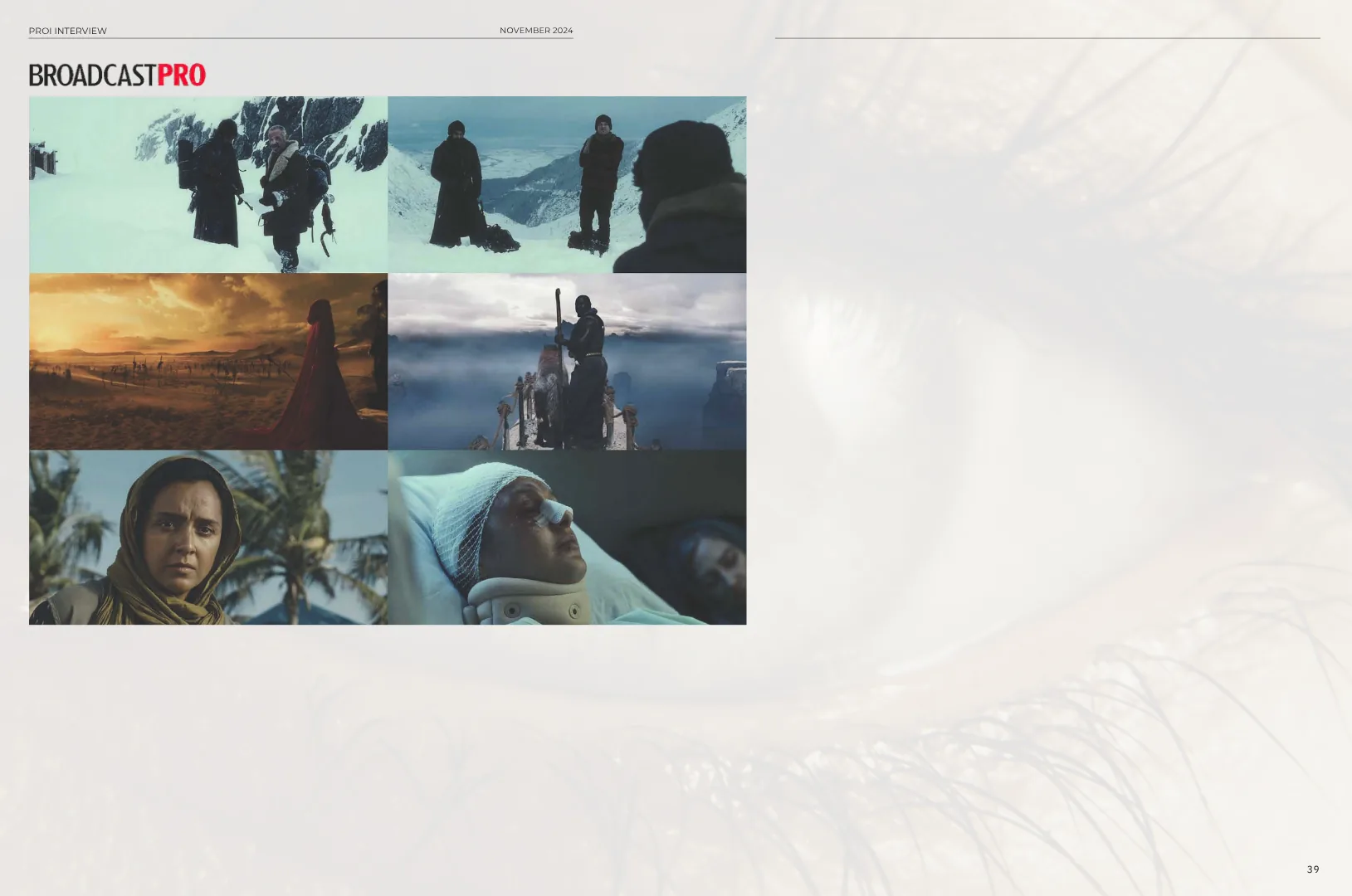
F: The Pact was developed at the studio from pre-production to final delivery, so I was part of the team from day one. The DP Steven Whitehead and producer/director Ahmed Al Baker had a very clear vision, so I explored different styles until we arrived at the harsh, cold
and raw feeling for this post-apocalyptic show. One main challenge was the large amount of VFX—we created a solid workflow
with AUTOMATIK to automate all plate extraction, making the process extremely fast.
“What are you working on now/next?”
F: I am currently working on a feature film titled Where is Saood, one of seven projects recently approved by Katara Studios—including films and TV series.
FilmLight — Feature on Baselight and post-production with Fady Melek.
Fady Melek, a senior colourist with 15+ years of experience in the film industry, was at Katara Studios from 2017 to 2024, where he worked on colour grading films and TV series, as well as managing complex workflows for demanding VFX projects. He is now a freelance senior colourist based in São Paulo, Brazil.
He shares his journey as a colourist with BroadcastPro ME.
Tell us about your journey to becoming a colourist.
My journey began working in scanning and printing during the digital intermediate (DI) era. It was then that I discovered colour correction and immediately fell in love—it combined two of my favourite things: painting and technical knowledge. I became a Colourist’s Assistant and gradually worked my way up to Senior Colourist at Katara Studios.
Tell us about your experience as a film lab technician and how it influenced your transition to colour correction.
I went to university to study Chemistry and in my third year worked in a film laboratory in Egypt. We received film reels to scan and print, and I was immediately captivated by the art of cinema. Working in a laboratory, you perceive the power of printer lights and how completely they can transform an image. When I moved into colour correction, I used the same approach—rather than creating a look based on masks and keying, I opted for a more globally homogeneous effect. That is how my lab experience influenced my colour grading style.
Tell us about your role and work at Katara Studios.
Working as Senior Colourist and Head of Picture, I handle colour grading and visual development for virtually all content produced by the studio—from films and TV series to music videos, documentaries and commercials. It has been an exceptional period, not only for the technical level but also for being surrounded by like-minded professionals. It’s inspiring!
You work across a wide variety of content. How do you manage this diversity, and do you have a preference for any specific format?
At Katara Studios, we are exposed to all formats. One day I’m working on a feature film, the next I’m grading a World Cup music video. The credit goes to our post-production team, who created a system and pipeline that makes us very effective at handling multiple projects simultaneously. I enjoy all of it, but deep down, I am still a cinema lover above all.
Tell us more about how you work with skin tones.
Manipulating skin tones is a delicate and extremely important task. The viewer focuses heavily on this part of the image, and much of the story’s emotions are conveyed through the characters’ skin tones. Chromogen is my main tool. Colour cross-talk and selectively brightening skin tones separately from the overall image are extremely effective techniques.
Tell us about the post-production industry in the Middle East. What are the main opportunities and challenges?
The Middle East has always been a fertile ground for dramatic stories. There are many opportunities due to the wealth of history and narratives still unexplored. The main challenge I see is the slow development of a system that protects artists and filmmakers. My hope is that this evolves with the right leadership, able to maximise local talent and art and share it with the world.
What makes Baselight your preferred tool?
A solid workflow and reliable tools. Baselight offers the flexibility to work the way you want. But what really stands out is the innovation in the tools. When FilmLight releases a new tool in Baselight, you can be certain it will not disappoint or compromise the image during a colour grade.
Shades of Success — The creative eye of Fady Melek in the international industry.
Services
Common Questions
Why should I work with Fady?
15+ years across features, series, and commercials, with a film lab background most colourists don't have. That includes "Dreamers," Jung Kook's official 2022 FIFA World Cup song, alongside high-end brand commercials and award-winning feature films. What's left is making sure every grade serves what the director and DP actually pictured.
What formats and deliverables do you support?
All formats and resolutions — SDR, HDR, Dolby Vision, and DCP.
Do you work with Dolby Vision?
Yes — Fady is a Dolby Vision certified colourist, with projects delivered in DV for Apple and Roku.
Does he grade remotely?
Yes — via Baselight Connect, from anywhere in the world, with a pixel-perfect, colour-managed signal so a director or DP sees exactly what he sees, live, on their own monitor. All a client needs is a MacBook Pro or an iPad. Details at fadymelek.com/grading-studio.
Are you available to travel to work on-site?
Yes — available to travel and work on-site at a client's location, or grade remotely via Baselight Connect. Whichever fits the project.
What makes his approach different?
Before colour grading, Fady studied painting and chemistry, then spent years in a film lab scanning and printing actual film stock, watching printer lights physically transform an image — long before he ever touched a digital control surface. That's why skin tones and the physical behaviour of light come first in his grades, not the tools.